Adapt the prompts
Start with hobbies and everyday interests. Remove anything that does not fit your group.
FREE PRINTABLE ICEBREAKER BINGO
Give your group a set of friendly prompts and a reason to meet someone new.
5 × 5: at least 24 unique entries (up to 200). One word or phrase per line.
A free center square is available on 3 × 3 and 5 × 5 cards.
30 unique cards + caller’s checklist
A LITTLE LUCK. A LOT OF GOOD COMPANY.
MARK A SQUARE. MAKE A MEMORY.
Every card has a different arrangement.
Your PDF includes the cards you preview here.
GET READY TO PLAY
Start with hobbies and everyday interests. Remove anything that does not fit your group.
Explain whether each person can sign once or more than once, and let anyone skip a question.
Players find someone who matches a square, have a short conversation, and add their name.
REAL LISTS. READY TO PRINT.
Each free sample contains six different 5 × 5 cards, two per sheet, with a Free Space. The sample preview shows the first printed sheet. Edit a list to make a batch for your own guest count.
Thirty everyday prompts, without salary, health, politics or family-status questions. Give participants 8–12 minutes as a starting point, allow passing, and ask volunteers to share one connection afterwards. Confirm the time and movement rules with your group.
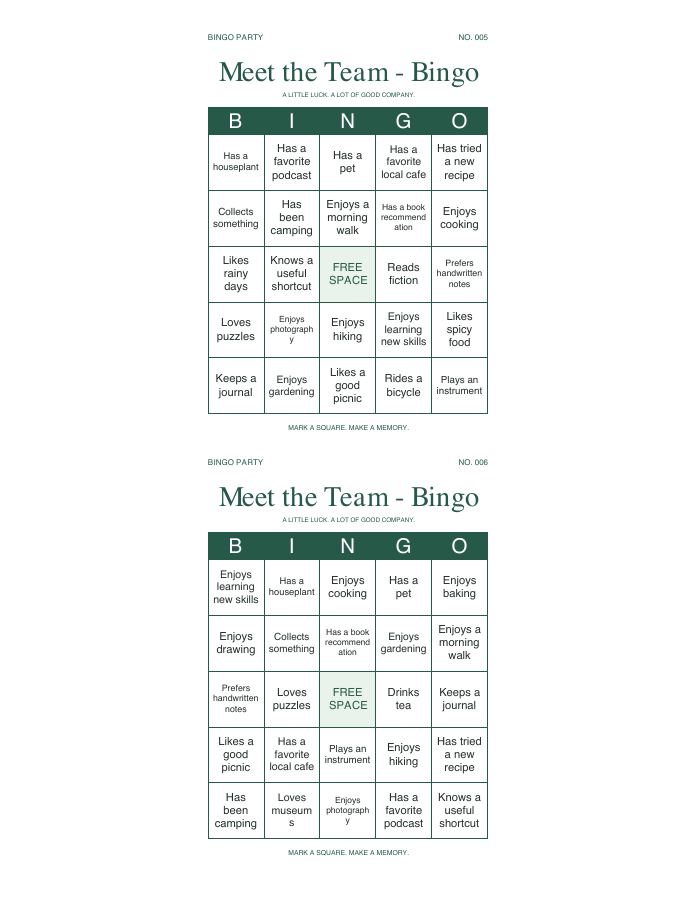
3-page sample: 3 card sheets. No caller checklist for this game. All players use the same word pool. Two people can still win together.
Thirty low-pressure preferences to adapt for your class. Read prompts aloud if needed, let students pass, and avoid asking for addresses, grades or private family details. Offer a seated partner version when mingling is not practical.
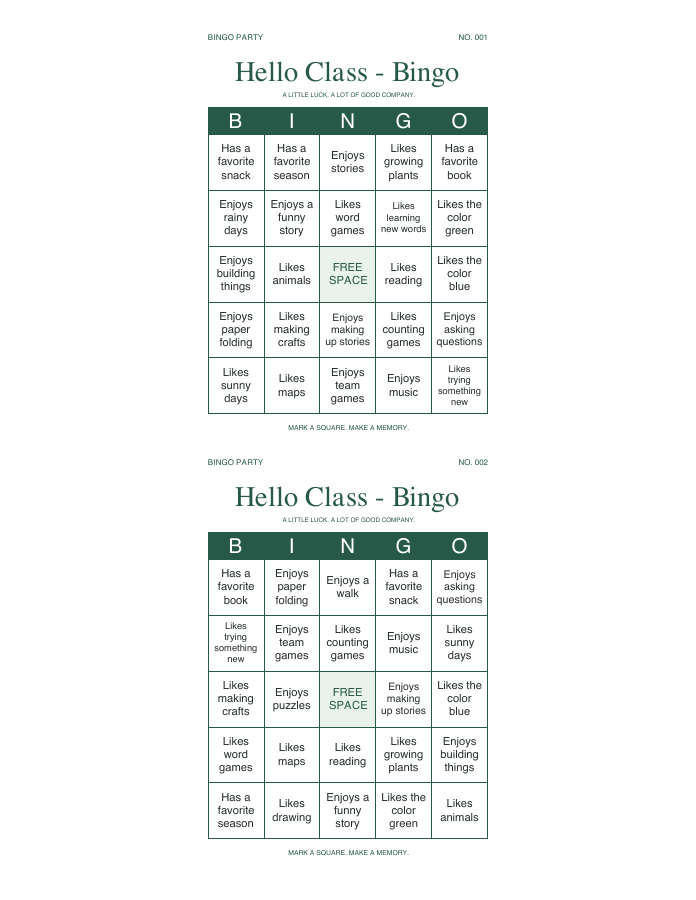
3-page sample: 3 card sheets. No caller checklist for this game. All players use the same word pool. Two people can still win together.
Thirty prompts for a group whose members do not all know each other. Start with a row, column or diagonal as the goal, and let participants choose how much to share. For a short session, switch to a 3 × 3 card in the editor.
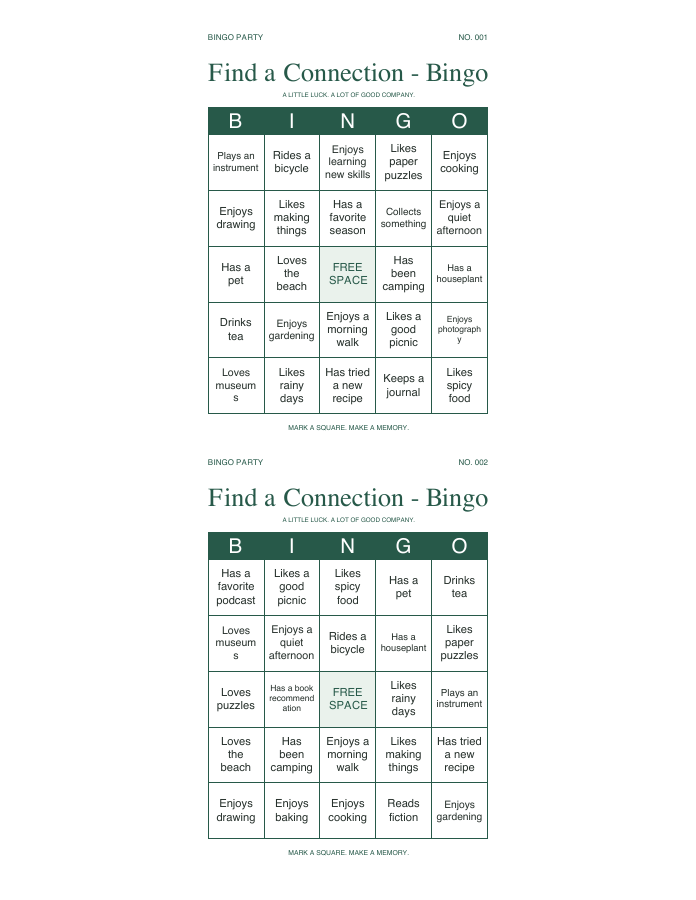
3-page sample: 3 card sheets. No caller checklist for this game. All players use the same word pool. Two people can still win together.
A HOST’S GUIDE
Review every prompt and choose topics that people can comfortably share. The starter list includes “Has a pet,” “Enjoys gardening” and “Plays an instrument.” For a workplace group, keep questions about interests rather than private matters. Let participants pass on any prompt. Print one card for each person and provide pens.
Ask players to move around and find someone who matches a square. After a short conversation, they write that person’s first name in the square. A useful starting rule is one signed square per person on each card; for a small group, allow repeat names. Choose a row, column or diagonal as the winning pattern and agree on a time limit.
A 3 × 3 grid with Free Space needs eight matched squares to fill the card, and fewer to make a line. It is a practical starting point for a short introduction. A 5 × 5 grid offers more prompts for a longer session. The tool does not know your group, so edit prompts that no one is likely to match. A caller’s checklist is optional and usually unnecessary for a mingling game.
For a seated group, ask people to talk with their table first, then switch tables if the setting allows. For a remote session, participants can print a card and talk in small breakout groups. These PDFs are printable cards rather than synchronized online game boards. End by inviting a few volunteers to share an interesting connection they made.
COMMON QUESTIONS
Usually not. Participants find people who match the prompts instead of waiting for words to be called. You can turn off the caller’s checklist before downloading.
That is a host decision. Limiting each person to one square encourages players to meet more people. For a small group, allowing repeats can make the game more practical. Explain the rule before starting.
You can adapt the prompts to the age and setting of your group. Review the list first, avoid sensitive personal questions, and make participation comfortable and optional. The tool itself is a printable card maker, not a student data collection system.
All themes and PDF downloads are free, with no signup. You can make up to 100 different arrangements per batch. Your words and PDF are processed in your browser and are not uploaded. Refreshing the page resets the editor.
READY FOR YOUR OCCASION